
Blogs
Choosing Wholesale Car Cleaning Products
Jun
A workshop can lose time fast when the wrong wash, degreaser or dressing is sitting on the shelf. The issue is not only cleaning performance. It is labour, rework, stock control and whether the product actually suits the vehicles coming through the bay. That is why buying wholesale car cleaning products needs a more practical approach than simply ordering in bulk.
For detailers, transport operators, dealerships and service departments, the best buying decisions usually come down to consistency. You need chemicals and accessories that perform the same way each time, across passenger vehicles, utes, vans, trucks and heavy fleet equipment. You also need a supplier that understands how these products are used in real operating conditions, not just how they look on a spec sheet.
What matters when buying wholesale car cleaning products
At wholesale level, product choice affects more than cleaning results. It affects workflow. A glass cleaner that flashes too slowly can hold up final presentation. A wheel cleaner that is too aggressive can create risk on sensitive finishes. An underpowered degreaser can turn a routine engine bay clean into a job that takes twice as long.
That is why experienced buyers tend to look at the full job chain. They consider how a pre-wash works with the main wash, whether the interior cleaner is safe across multiple surfaces, and whether dressings, polishes or deodorisers fit the finish standard expected by customers. In fleet environments, they also need products that can handle road film, grease, brake dust and grime without creating unnecessary complexity for staff.
There is always a balance to strike. A highly specialised chemical may produce excellent results on one task, but if your team needs a simpler system for day-to-day use, a more versatile product can be the better wholesale choice. The right range depends on your volume, vehicle mix and the skill level of the people using it.
Start with the vehicles and the work environment
A retail valeting business and a heavy transport operator do not have the same requirements, even if both are buying wholesale car cleaning products. One may need more focus on presentation, interior finishes and paint correction support. The other may care more about grease removal, truck wash performance and fast turnaround for large units.
That is why the first question should be about the actual cleaning environment. Are you working indoors or outside. Are vehicles cleaned daily, weekly or only when they come in for service. Do you need products that perform well in colder conditions, on road grime, or under high-use commercial washing schedules. These details shape what should be kept in regular stock.
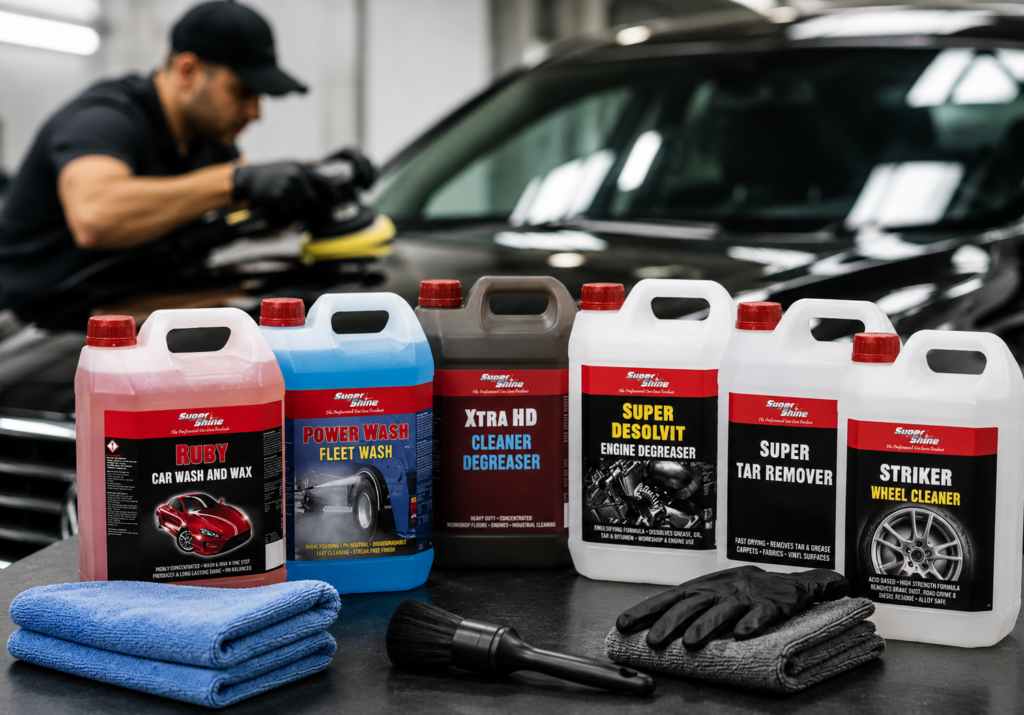
For mixed operations, a broad but controlled range often works best. General washes, wheel cleaners, glass cleaners, carpet cleaners, dressings and hand cleaners are core items in most facilities. From there, more specialised products such as engine cleaners, solvents, brake cleaners, deodorisers, waxes and polishes can be added based on actual usage rather than guesswork.
Chemicals should match the task, not fight it
Too many businesses end up with duplicate products because nobody reviewed what each one was actually doing. If two degreasers are being used for the same job, or if staff keep reaching for a stronger chemical because the standard product is not performing, that is a sign the range needs tightening up.
A well-planned wholesale supply setup should reduce overlap. It should give the team a clear product for washing, a clear product for grease and oil, a safe cleaner for interiors, and fit-for-purpose options for glass, wheels, carpets and finishing. Simplicity matters because simple systems are easier to train, easier to reorder and less likely to cause costly mistakes.
Why supply reliability matters as much as product quality
Even a strong product range can become a problem if supply is inconsistent. Running out of a high-use wash or wheel cleaner can disrupt daily output quickly, especially in fleet, dealership and workshop settings where vehicles need to be turned around without delay.
This is where wholesale support makes a real difference. Buyers should be looking for dependable stock availability, straightforward ordering, and account support from people who understand the category. If a product substitution is needed, it should be handled by someone who can explain the change and recommend a practical equivalent, not leave staff to work it out on the floor.
Local support also matters when technical questions come up. Chemical handling, dilution guidance, surface compatibility and safety documentation are not minor details. They are part of running a compliant, efficient operation. A supplier that can support these requirements is far more useful than one that simply ships cartons.
Accessories are part of the system
Wholesale purchasing should not stop at chemicals. Brushes, spray bottles, triggers, cloths, wash tools and applicators all influence job speed and finish quality. A strong cleaner paired with the wrong accessory can still lead to poor results, while the right tool can improve consistency and reduce waste.
This is particularly relevant in high-volume operations where staff rotate between tasks. Standardised accessories help maintain process control. When every bay is using the same setup, it is easier to train new staff, monitor usage and maintain finish standards across the business.
The real value of a complete range
Many automotive businesses prefer to buy from one supplier because it simplifies purchasing, but convenience alone is not the main advantage. The bigger benefit is compatibility across the range. When washes, dressings, wheel cleaners, interior products and workshop cleaners are selected as part of one supply plan, it becomes easier to build a cleaning process that is consistent from start to finish.
That matters for both appearance and operations. A dealership wants vehicles to present clean and ready without streaking, residue or rushed finishing. A transport business wants truck cleaning products that hold up under hard use and still fit practical wash routines. A detailing operation wants reliable performance across paint, glass, trim, wheels and interiors. In each case, a complete wholesale range helps remove friction.
This is also where an experienced supplier earns its place. Businesses that have been in the trade for decades tend to understand which products are everyday essentials and which are niche. They can help buyers avoid overcomplicating the shelf while still covering the jobs that matter.
How to assess wholesale car cleaning products before committing
The safest approach is to assess products against operational outcomes, not marketing claims. Ask whether the product saves time, improves finish consistency, reduces rework and suits the surfaces you clean most often. If it performs well but requires a complicated process that staff are unlikely to follow, it may not be the right fit.
It also helps to look at concentration and usage patterns. A product that is easy to dilute correctly and apply consistently usually delivers better real-world value than one that appears strong but is prone to overuse or misuse. For workshops and fleet depots, ease of use is not a minor issue. It directly affects consumption rates and day-to-day efficiency.
Trialling products across a few representative jobs is often the best test. Use them on a daily driver, a commercial van, a truck or trailer, and an interior clean with typical soil levels. That gives a better picture than a one-off test on an already clean vehicle.
Where local conditions come into play
Vehicle cleaning in New Zealand conditions can vary more than people expect. Coastal exposure, road grime, mud, freight routes and workshop contamination all affect product performance. A product range needs to cope with what is actually landing on the vehicle, not just ideal conditions.
That is one reason trade buyers often prefer suppliers with local manufacturing knowledge and field experience. The products are more likely to be selected with practical conditions in mind, and support tends to be more relevant when issues come up.
SuperShine has worked with automotive and commercial operators since 1992, and that kind of trade exposure matters when businesses need wholesale supply that is dependable, practical and built around real cleaning demands.
The best wholesale setup is rarely the biggest one. It is the one that keeps your team moving, gives predictable results and makes reordering straightforward. If your current range is creating confusion, waste or inconsistent finishes, it may be time to strip it back and rebuild around products that actually suit the work. A cleaner operation usually starts with a smarter shelf.
