
Blogs
Choosing Commercial Vehicle Wash Systems
Jun
A dirty truck is rarely just a cosmetic issue. Road film hides defects, brake dust builds up around wheels, greasy residue collects around engine bays and trailers, and a poorly washed fleet can make a capable operation look careless. That is why commercial vehicle wash systems matter – not as a nice-to-have, but as part of keeping vehicles presentable, serviceable and ready for work.
For fleet managers, workshop operators and professional wash bay buyers, the right system is the one that fits the way vehicles actually arrive on site. That means looking beyond brochure claims and focusing on traffic volume, contamination type, turnaround expectations and the chemicals needed to get a reliable result without wasting labour, water or product.
What commercial vehicle wash systems need to do
At a practical level, commercial vehicle wash systems have three jobs. They need to remove soil efficiently, protect vehicle surfaces and keep the wash process consistent across different operators and vehicle types. If one person gets a strong result and the next leaves road grime on lower panels or streaks on glass, the system is not properly set up.
Heavy vehicles create a different cleaning challenge from passenger cars. Trucks, vans, buses and service utes collect more diesel soot, traffic film, mud, salt, grease and carbon around high-contact areas. Wheel arches, chassis sections, fuel tank surrounds and rear doors usually need more than a standard shampoo pass. In many sites, the system also has to cope with mixed-use fleets, which means one day it is washing courier vans and the next it is dealing with livestock trailers or earthmoving support vehicles.
That is where buyers often go wrong. They choose a wash system based on equipment alone, when the chemistry and application method are just as important. A good arch or pressure setup will still underperform if the pre-wash is wrong for the soil load, the dilution is inconsistent or the dwell time is too short.
The main types of commercial vehicle wash systems
The best format for your operation depends on volume, available space and how clean vehicles need to be before they leave the site.
Manual wash bay systems
Manual systems are still the right fit for many commercial operators. They usually combine pressure washers, foam or spray application, brushes where appropriate and a defined chemical process for pre-wash, main wash and finishing stages. This approach gives staff more control around problem areas such as bug build-up, polished alloy, wheel faces and greasy lower panels.
The trade-off is labour. Manual washing can deliver an excellent finish, but only if staff are trained properly and the process is consistent. If labour availability is tight or vehicles need to move through quickly at peak times, a fully manual setup can become a bottleneck.
Drive-through and rollover systems
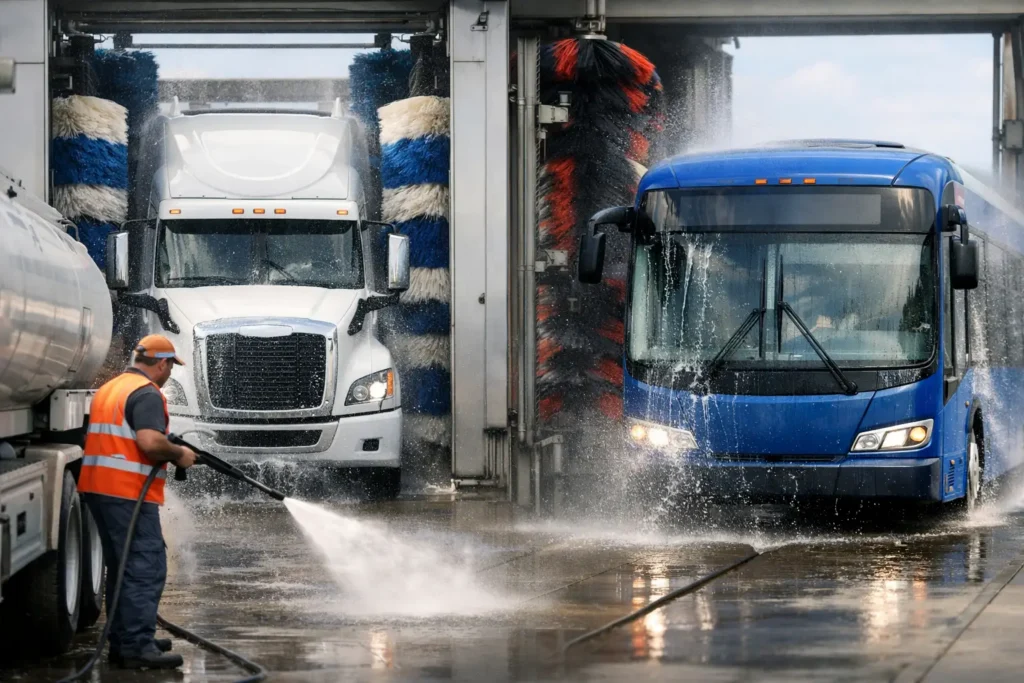
For larger fleets with predictable vehicle sizes, automated systems can improve throughput and reduce variability. Drive-through and rollover units suit operations where speed matters and where a repeatable wash standard is more important than hand-finished detailing.
These systems work best when the incoming soil load is moderate and vehicles are washed frequently. If trucks arrive heavily contaminated with grease, clay, road tar or thick mud, automation alone may not be enough. In those cases, a pre-treatment stage or manual intervention is often needed before the machine can do its job properly.
Combination systems
Many professional sites end up with a hybrid model. A fixed wash system handles the bulk cleaning, while staff step in for pre-spray, wheel work, degreasing or final touch-up. For mixed fleets, this is often the most sensible setup. It keeps throughput moving while still dealing with the stubborn contamination that machines tend to miss.
Why chemistry matters as much as equipment
A wash system is only as good as the products running through it. Commercial buyers sometimes focus heavily on pressure, brush design or water recycling and then treat chemicals as an afterthought. In practice, the wash chemical often determines whether the system cleans effectively, rinses freely and leaves a professional finish.
High-foaming products can look impressive, but foam alone does not equal cleaning power. What matters is whether the product is matched to the soil type and surface. Alkaline cleaners can be very effective on traffic film and grime, but they need to be used correctly around sensitive finishes. Degreasers may be essential in workshop and heavy transport environments, but overuse can affect surfaces or increase rinse demand. Acidic wheel cleaners have their place, though not on every wheel type or every maintenance program.
The better approach is to build the system around a clear chemical sequence. A pre-wash to break down heavy soil, a controlled main wash for general cleaning, and specialised products for wheels, glass, engine bays or interior work where needed. That gives operators a repeatable process instead of relying on one product to do everything badly.
Water use, drainage and compliance are part of the buying decision
A commercial wash setup has to work on paper as well as in the bay. Water supply, pressure stability, drainage capacity and wastewater handling all affect system performance. A high-output wash system with poor drainage quickly becomes inefficient and messy, especially when mud, grit and chemical residue build up around the work area.
Water recycling can make sense in some sites, particularly where wash frequency is high. But recycled water systems need proper maintenance and should be matched to the finish standard expected. If the goal is a presentation-ready fleet, final rinse quality still matters.
Compliance also matters. Buyers need to consider runoff control, safe chemical handling, dilution accuracy and access to product documentation. In a trade setting, this is not red tape for the sake of it. It is part of keeping staff safe, protecting equipment and making sure the wash process can stand up to scrutiny.
Matching the system to your fleet
No two fleets are the same, even if the vehicle count looks similar. A metropolitan delivery fleet that washes every two days has different needs from a civil contractor washing mud-heavy units at the end of a shift. A dealership transport operator will care more about finish quality than a quarry support fleet, while a workshop may need stronger degreasing capability than either.
That is why the first question should not be, which machine is best? It should be, what are we washing, how often, and what does a good result look like for our operation?
Vehicle size is the obvious factor, but not the only one. Wash frequency affects how aggressive the chemistry needs to be. Soil type determines whether touchless application is realistic or whether brushing will still be required. Labour availability influences whether automation will provide genuine value. Site layout can limit what is physically possible.
If your fleet includes signwritten vehicles, polished metal, specialty coatings or mixed substrates, product compatibility becomes even more important. Stronger is not always better. A fast clean that dulls surfaces or shortens coating life is an expensive shortcut.
Common mistakes with commercial vehicle wash systems
One of the most common mistakes is underestimating pre-treatment. Operators expect the main wash stage to remove everything, when heavy soil really needs time and the right chemical to break down first.
Another is poor dilution control. Overdosing wastes product and can create residue or surface issues. Underdosing leads to weak cleaning, repeat washing and frustrated staff. Metering and training make a real difference here.
There is also the issue of process drift. A wash bay may start with a sound procedure, but over time operators skip steps, swap products around or apply chemicals in the wrong order. The result is inconsistent cleaning and avoidable rework. The best systems are supported by simple procedures that people can follow under pressure.
What good support looks like
Buying equipment is only part of the decision. Ongoing product supply, technical guidance and access to the right accessories are what keep a system performing over time. That includes advice on chemical selection, dilution, application methods, safety data and troubleshooting when results change due to seasonal conditions or different soil loads.
For many commercial operators, the ideal supplier is not just moving boxes. They understand fleet cleaning, know how wash chemistry behaves in real conditions and can help refine the process when the current setup is wasting time or product. That practical support is often what separates a wash system that looks fine on day one from one that still works properly six months later.
SuperShine has worked with professional vehicle care operators since 1992, and that trade experience matters when the requirement is clear – dependable cleaning performance without unnecessary complication.
The right wash system is not the fanciest one on the market. It is the one that fits your vehicles, your site and your standard of finish, then delivers that result day after day with products and support you can rely on. If you get that part right, a cleaner fleet stops being another task to manage and becomes part of how your operation presents itself every time a vehicle leaves the yard.
